Elevate Your Data Management Strategy with Advanced External SSDs and RAID Configurations in 2024
In today’s fast-paced digital environment, professionals and tech enthusiasts alike recognize that optimizing data access speed is not merely a convenience but a necessity. As storage technologies evolve, understanding how to leverage external SSDs and RAID configurations becomes crucial for achieving superior performance, especially in high-demand scenarios like video editing, data analysis, and enterprise-level backups. This article delves into expert insights and the latest innovations shaping the future of fast data access, emphasizing strategic selection and configuration of external storage solutions.
Why External SSDs Have Become the Cornerstone of High-Performance Storage
External SSDs, particularly NVMe-based models, have revolutionized portable data management by offering unprecedented speed and reliability. Unlike traditional SATA SSDs, NVMe drives utilize PCIe lanes to deliver bandwidths that significantly reduce latency, making them ideal for professional workflows requiring rapid data transfer. For instance, in creative industries, using NVMe SSDs for scratch disks can drastically cut down rendering and rendering times, boosting productivity.
Implementing RAID for Maximal Data Throughput and Resilience
RAID (Redundant Array of Independent Disks) configurations fundamentally enhance data access speeds and redundancy. Experts recommend multi-disk RAID setups like RAID 0 or RAID 10 for high-speed environments. RAID 0 combines multiple SSDs to aggregate bandwidth, providing a seamless data pipeline ideal for editing large multimedia files. Conversely, RAID 10 offers a balanced approach, combining performance with redundancy, crucial for critical enterprise data. For comprehensive guidance, consult this authoritative RAID storage resource.
How to Balance Cost, Speed, and Data Security Effectively
While high-end NVMe SSDs and complex RAID configurations promise optimal performance, cost remains a decisive factor. Professionals should consider hybrid solutions, such as external SSDs paired with software-based RAID or NAS systems, to tailor their storage architecture to specific needs. Moreover, ongoing advancements in PCIe 4.0 and PCIe 5.0 SSDs promise further speed gains, as detailed in this recent white paper. Such innovations underscore the importance of staying adaptable and informed about emerging storage technologies.
What are the practical implications of integrating RAID with external NVMe SSDs in a professional workflow?
Integrating RAID with external NVMe SSDs allows for unprecedented data throughput and fault tolerance, especially when configured with Thunderbolt 3 or 4 interfaces that support high bandwidths. This setup enables real-time editing of 4K or 8K footage, rapid backup, and seamless data replication across multiple drives, effectively minimizing downtime and data loss risks. As this technology matures, experts are exploring hybrid RAID models that combine hardware and software solutions for enhanced flexibility. For further insights, explore this comprehensive guide.
To maximize your data access speed in 2024, continuously evaluate emerging SSD technologies and RAID configurations aligned with your operational demands. For tailored advice or to share your experiences, connect with our expert team.
Unlocking Hybrid Storage Solutions for Peak Performance
While individual NVMe SSDs offer remarkable speed, integrating them within a RAID array amplifies their potential, delivering both high throughput and fault tolerance. For professionals managing large datasets or real-time editing workflows, combining external NVMe drives with hardware or software RAID configurations is transformative. This approach reduces bottlenecks and enhances data security, especially when paired with Thunderbolt 4 interfaces that support multi-gigabit bandwidths. For optimal setup, consult this comprehensive guide.
Are We Underestimating the Power of Emerging Storage Technologies?
As the industry accelerates towards PCIe 5.0 and beyond, many professionals overlook the rapid advancements in SSD control chips and NAND flash memory that can significantly impact performance metrics. For example, the latest NVMe SSDs leverage new controller architectures to reduce latency further, which, when combined with RAID 0 or RAID 10, can push data transfer speeds well beyond traditional limits. Staying ahead requires constant evaluation of these innovations, as highlighted in this white paper.
How can experts leverage these cutting-edge storage solutions to streamline creative workflows?
Professionals can implement tiered storage architectures, deploying NVMe SSDs for active projects and slower, more cost-effective drives for archival purposes. Additionally, integrating external SSDs into RAID arrays ensures rapid data access while maintaining redundancy, crucial for high-stakes environments like live video editing or scientific research. For insights into choosing optimal configurations, explore this expert advice. To further enhance your setup, consider optimizing your scratch disks with dedicated NVMe SSDs, which can significantly reduce rendering times and boost productivity.
If you’re eager to refine your storage infrastructure, don’t hesitate to reach out with your questions or share your experiences. Connect with our team via this contact page.
Future-Proof Your Storage with Cutting-Edge PCIe 5.0 SSDs and Dynamic RAID Arrays
As industry leaders race to push the boundaries of data transfer speeds, PCIe 5.0 SSDs are emerging as game-changers, offering twice the bandwidth of PCIe 4.0 counterparts. These drives leverage innovative controller architectures and NAND Flash advancements to deliver ultra-low latency and exceptional throughput, essential for demanding tasks like 8K video editing and scientific simulations. Integrating these SSDs within flexible RAID configurations unlocks unprecedented levels of performance and resilience, transforming workflows for professionals who cannot afford bottlenecks.
Why Multi-Layered Storage Architectures Are No Longer Optional
In complex operational environments, a hybrid approach combining high-speed NVMe SSDs with traditional HDDs or cloud solutions delivers optimal results. Tiered storage strategies enable real-time access to active data while archiving or backing up less frequently accessed information, reducing costs without sacrificing speed. For example, deploying an NVMe RAID array for active projects ensures rapid data manipulation, while slower drives or cloud backups secure the data integrity and disaster recovery capabilities. As noted by tech analysts at Storage Performance Magazine, this approach minimizes downtime and maximizes throughput.
How does integrating emerging SSD controllers influence overall system performance?
New controller architectures optimize data flow by reducing latency and managing NAND Flash wear more efficiently. They employ techniques like multi-queue command processing and adaptive error correction, which significantly elevate sustained throughput and drive longevity. This technological leap allows RAID arrays to operate at peak efficiency, even under continuous heavy workloads. Industry reports from NAND Tech Journal detail how these controllers are redefining SSD capabilities.
To stay ahead, IT professionals should consider investing in the latest SSDs equipped with these advanced controllers and adopt RAID configurations that match their specific data demands. The combination serves as a robust foundation for high-availability systems and lightning-fast data processing pipelines.
Seamless Data Synchronization and Real-Time Collaboration with External RAID Arrays
External RAID arrays connected via Thunderbolt 4 or USB 4.0 interfaces now provide the bandwidth necessary for real-time collaboration on massive datasets. This setup enables multiple users to access, edit, and share high-resolution media or scientific data simultaneously without compromising speed or stability. Implementing hardware RAID controllers within these external enclosures simplifies configuration and enhances fault tolerance, ensuring continuous operation during component failures.
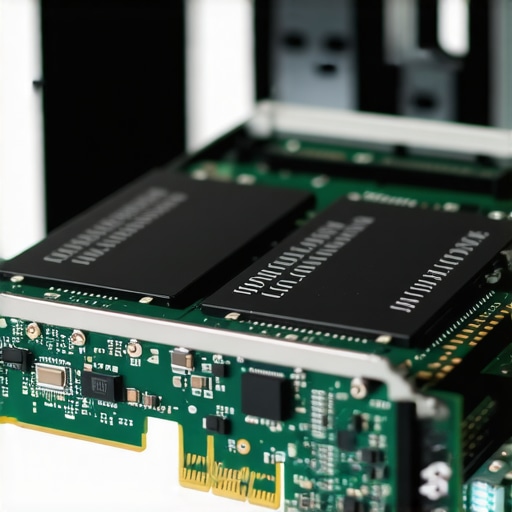
Illustration of a high-performance external RAID array connected via Thunderbolt 4 interface, highlighting data flow and redundancy features.
Are We Ready for the Next Wave of SSD and RAID Innovations?
With ongoing developments in PCIe 6.0 and emerging storage protocols like CXL (Compute Express Link), the potential for even faster and more intelligent storage solutions is imminent. These technologies promise to reduce latency further and enable dynamic resource pooling across heterogeneous devices, revolutionizing data centers and high-performance workstations alike. Experts from Data Center Dynamics predict that early adoption of these innovations will confer significant competitive advantages.
How can forward-thinking organizations leverage these advancements to streamline their data workflows?
Early integration of PCIe 6.0 SSDs with adaptive RAID architectures will allow organizations to handle exponential data growth efficiently. Employing AI-driven management tools to optimize storage allocation and predictive maintenance ensures maximum uptime and cost savings. Continuous education on emerging standards and active participation in industry consortiums will empower organizations to anticipate and implement next-generation storage solutions proactively.
If you’re eager to elevate your data infrastructure, consult with our experts to tailor a high-performance storage strategy aligned with your unique operational needs. Reach out today via our contact page and stay ahead in the data race.
Harnessing the Latest Storage Technologies for Competitive Advantage
As data demands escalate, professionals must leverage cutting-edge external SSDs combined with sophisticated RAID configurations to maintain a technological edge. The integration of PCIe 5.0 SSDs with multi-layered RAID arrays offers unprecedented throughput, enabling seamless 8K video editing, high-volume scientific computations, and rapid backups. These innovations are critical for organizations aiming to minimize latency and maximize data security in real-time operational environments.
Why NVMe SSDs Transform Portable Data Management
NVMe SSDs utilize PCIe lanes to deliver superior speed and lower latency compared to SATA counterparts, revolutionizing portable storage solutions. Their ability to handle intensive workflows—like 3D rendering or large dataset processing—makes them indispensable. According to a detailed analysis by AnandTech, the latest NVMe controllers optimize NAND management, significantly extending SSD lifespan while improving performance under sustained loads.
Optimal RAID Strategies for High-Performance Environments
Expert-level data architectures favor RAID 0 or RAID 10 configurations when maximizing throughput is vital. RAID 0 aggregates multiple NVMe drives for raw speed, ideal for active projects, while RAID 10 balances speed with redundancy, suitable for critical data repositories. Advanced users should consider hardware RAID controllers with cache management and hot-swappable drives to enhance resilience and reduce downtime. For in-depth guidance, consult this authoritative resource.
Balancing Cutting-Edge Performance with Cost Efficiency
While PCIe 5.0 SSDs and hardware RAID arrays promise maximal performance, budget constraints necessitate hybrid solutions. Combining external NVMe drives with software-managed RAID or NAS units provides scalable options. As PCIe 4.0 and 5.0 SSDs become more affordable, organizations should consider phased upgrades aligned with their workload priorities. The White Paper from Storage Performance emphasizes adaptive strategies for cost-effective high-speed storage deployment.
How can specialized configurations accelerate complex creative workflows?
Implementing tiered storage—using NVMe RAID arrays for active projects and slower drives for archival—streamlines data access and minimizes bottlenecks. For creative professionals, dedicated NVMe scratch disks significantly reduce rendering times, accelerating project turnaround. Additionally, real-time data synchronization across external RAID setups ensures uninterrupted collaboration for teams working on high-resolution media. Explore this expert advice for tailored configurations.
Engage with our specialists to optimize your storage infrastructure, ensuring it evolves with emerging technologies and your operational needs. Reach out via our contact page.
Embracing Future-Ready Storage Innovations
The advent of PCIe 6.0 and the development of CXL protocols promise to redefine data transfer capabilities, enabling dynamic resource pooling and intelligent caching. Early adoption of these technologies facilitates scalable, low-latency environments suitable for high-demand scientific and creative workflows. Industry experts at Data Center Dynamics forecast that integrating these advancements will be a strategic differentiator for forward-looking organizations.
What strategic steps should organizations take to capitalize on next-generation storage breakthroughs?
Proactively investing in PCIe 6.0 SSDs, coupled with AI-driven management tools, allows for predictive maintenance and optimized data flow. Participating in industry consortiums and staying informed on evolving standards ensures readiness for seamless integration. These measures will position organizations to handle exponential data growth efficiently, maintaining competitive agility. For tailored strategic advice, contact our team today.
Innovative Approaches to Data Storage Efficiency
In 2024, leveraging external SSDs and RAID arrays requires a strategic mindset that balances cutting-edge technology with practical application. Experts emphasize the importance of integrating PCIe 5.0 SSDs within multi-layered RAID setups to achieve unprecedented data throughput, crucial for demanding creative and scientific workflows. Staying ahead involves adopting tiered storage architectures that combine rapid NVMe drives for active data with traditional HDDs or cloud solutions for archiving.
Maximize Performance with Hardware Acceleration
Utilizing hardware RAID controllers equipped with intelligent cache management and hot-swappable drives can significantly reduce downtime and facilitate rapid recovery after failures. The integration of Thunderbolt 4 interfaces further enhances external RAID configurations, enabling seamless, high-bandwidth data transfer for real-time editing and collaboration. Industry leaders recommend maintaining a balance between cost and performance by selecting scalable solutions that adapt to evolving data demands.
Expert Resources for Advanced Storage Solutions
- Storage Performance Magazine – Offers in-depth analysis of tiered storage strategies and the latest advancements in SSD controller architectures.
- NAND Tech Journal – Provides detailed reports on emerging NAND flash technologies and their impact on SSD longevity and performance under sustained loads.
- Data Center Dynamics – Explores next-generation storage protocols like PCIe 6.0 and CXL, guiding organizations on early adoption and integration strategies.
- White Paper on Adaptive RAID Architectures – A comprehensive guide to designing flexible, high-throughput RAID environments tailored for high-demand applications.
Reflections from a Storage Technology Authority
As we navigate the rapidly evolving landscape of external SSDs and RAID configurations, the key takeaway is the necessity of foresight and adaptability. Embracing technologies like PCIe 5.0 SSDs and multi-layered storage architectures positions professionals at the forefront of performance and security. The future belongs to those who combine expert insights with strategic implementation, ensuring data access remains swift, reliable, and secure. For those committed to excellence in data management, engaging with industry-leading resources and continuously refining your infrastructure is paramount. To deepen your expertise or share insights, connect with professionals through our contact page and stay ahead in this competitive field.