Harnessing the Full Potential of External Storage Technologies for High-Performance Data Workflows
In the rapidly evolving landscape of data storage, professionals must navigate a complex array of options—ranging from NVMe and SATA SSDs to sophisticated RAID configurations—each offering unique advantages and challenges. With advancements in interface protocols like Thunderbolt 5, understanding how to optimize external SSDs and integrate them effectively into enterprise and creative environments is crucial for maintaining competitive edge and operational efficiency.
Deciphering the Role of NVMe, SATA, and RAID in Modern External Storage Architectures
NVMe SSDs, leveraging PCIe 4.0 and beyond, deliver unparalleled speeds essential for demanding applications such as 8K video editing and real-time data analysis. Conversely, SATA SSDs, while offering lower prices and broad compatibility, still serve as reliable options for scratch disks and incremental data caching. When combining these drives within RAID arrays—be it RAID 0 for speed or RAID 10 for redundancy—it’s vital to recognize that the configuration directly influences data throughput, fault tolerance, and scalability.
Addressing Thunderbolt 5 Speed Drop: Insight into Fixes and Future-Proofing
Recent benchmarks reveal that despite Thunderbolt 5’s theoretical capacity of up to 80 Gbps, real-world performance often encounters bottlenecks, especially when interfacing with high-speed NVMe SSDs. Expert analyses suggest that implementing effective cooling solutions, optimizing firmware, and fine-tuning host system configurations can mitigate these drops. For instance, leveraging PCIe throttling fixes enhances stability and restores peak performance, ensuring external SSDs operate at their intended speeds.
What Are the Key Factors That Influence External SSD Performance in 2026?
Performance hinges on multiple variables: interface protocol efficiency, thermal management, drive controller quality, and system bus architecture. Advanced cooling techniques, such as heat sink integration and airflow optimization, prevent thermal throttling that diminishes throughput—an issue prevalent with the latest NVMe models during sustained heavy workloads. Furthermore, choosing high-quality controllers and firmware that support upcoming interface standards ensures compatibility and longevity of the storage setup.
Optimizing RAID Configurations for High-Speed Data Access and Reliability
Designing RAID arrays for external SSDs demands an expert grasp of the trade-offs between speed, redundancy, and rebuild times. For instance, RAID 0 accelerates data access but exposes data to higher risk; meanwhile, RAID 6 or RAID 50 provide fault tolerance at the expense of some write performance. How can professionals tailor these configurations to specific workflows—such as 16K video edits or database operations—to maximize both performance and resilience? Practical strategies include deploying NVMe SSDs in RAID 0 for cache acceleration, complemented by periodic backups and monitoring tools like comprehensive RAID management guides.
How does the integration of external SSDs influence the overall data pipeline efficiency, especially when considering emerging interface standards like USB 4.2 and Thunderbolt 5?
As interface protocols evolve, compatibility and bandwidth will increasingly determine the design and deployment of external high-speed storage solutions. To capitalize on these advancements, organizations must adopt a strategic approach—balancing interface capabilities with thermal management and NAS or SAN integration—to future-proof their infrastructure and reduce latency in data-intensive tasks.
For technical professionals interested in deepening their expertise, exploring comprehensive external SSD and RAID solutions can provide valuable insights into scaling high-performance storage architectures.
Why Thermal Management Is the Unsung Hero of Speed Reliability
While interfaces like Thunderbolt 5 and PCIe 5.0 set high-speed benchmarks, effective thermal management often determines real-world performance stability. Excessive heat causes thermal throttling, which caps data transfer rates and jeopardizes data integrity during lengthy intensive tasks such as 8K editing or large database migrations. Implementing advanced cooling solutions—such as custom heat sinks, airflow optimization, or even liquid cooling—goes beyond traditional methods and ensures SSDs operate at peak speeds. According to industry experts, integrating thermally conductive materials directly into SSD enclosures significantly reduces thermal bottlenecks, extending drive lifespan and maintaining consistent performance.
Can AI-driven firmware optimization push external SSD speeds to new limits in 2026?
Emerging trends point toward artificial intelligence (AI) and machine learning algorithms embedded within SSD firmware, enabling intelligent management of workload distribution, temperature regulation, and error correction. Such innovations promise to unlock hidden performance potentials and adapt dynamically to user workflows. As the storage industry shifts toward smarter hardware, expect external SSDs to become self-optimizing, with firmware that predicts and mitigates bottlenecks before they occur. For a technical deep dive on this evolving frontier, reviewing cutting-edge external SSD solutions can be invaluable.
Maximizing Data Throughput with Strategic Interface Utilization
As interface protocols diversify, adopting the right connection standards becomes pivotal. While Thunderbolt 5 offers up to 80 Gbps bandwidth, integrating with USB 4.2 or latest PCIe standards can further streamline workflows, especially in mixed-traffic environments. Ensuring compatibility involves selecting enclosures and host systems that support these protocols natively, avoiding bottlenecks caused by protocol translation or outdated hardware. Moreover, leveraging multi-interface docks allows simultaneous data streams, effectively aggregating bandwidth for complex operations like real-time 8K editing or large-scale backups.
For insights into future interface capabilities and connection planning, exploring advanced external storage configurations can guide strategic investments.
Integrating External SSDs into High-Availability Data Ecosystems
Modern data workflows demand not just speed, but resilience. Incorporating external SSDs into high-availability architectures involves more than simple RAID arrays; it requires careful planning around data replication, backup strategies, and failover mechanisms. Combining external NVMe SSDs in RAID 0 for temporary processing with RAID 6 or RAID 50 configurations for long-term storage creates a flexible, resilient environment that mitigates downtime and data loss. Employing cloud sync and off-site backups further enhances disaster recovery readiness. This multi-layered approach ensures speedy access without sacrificing safety, aligning with best practices outlined in authoritative guides such as RAID and data protection frameworks.
Interested in designing a future-proof storage setup? Contact our experts to customize an optimal external RAID solution tailored to your needs.
,
Leverage Firmware Intelligence for Dynamic SSD Optimization
Emerging firmware algorithms powered by artificial intelligence are revolutionizing external SSD performance, offering real-time adaptability to workload fluctuations. By analyzing data transfer patterns, temperature trends, and error rates, these intelligent systems can adjust operating parameters proactively—such as dynamic frequency scaling or error correction levels—ensuring sustained peak performance and data integrity. Companies like Samsung with their SmartSSD platform exemplify this trend, integrating machine learning to predict and prevent potential bottlenecks before they manifest. How might future firmware innovations further personalize storage performance based on specific application profiles? For professionals seeking cutting-edge solutions, exploring the integration of AI-driven firmware is essential to maintain a competitive edge.
The Art of Seamless External Storage Integration in Cutting-Edge Workflows
As data environments become increasingly intricate, the sophistication with which professionals orchestrate external storage solutions can profoundly influence operational efficiency. Modern approaches involve not only selecting the right drives but also meticulously harmonizing interface standards like Thunderbolt 5 and USB 4.2 with system architectures. This orchestration minimizes latency, enhances throughput, and ensures compatibility with emerging computing paradigms such as edge processing and distributed storage networks. An intricate understanding of these components enables technicians to craft streamlined data pipelines capable of supporting real-time editing, AI-driven analytics, and massive data migrations—domains where milliseconds matter.
Will NVMe SSD Configurations Outperform Traditional RAID Arrays in Data-Intensive Tasks?
Recent analytical reports from OpenEdge Reliability Institute suggest that directly connected NVMe SSDs, optimized via intelligent firmware, can surpass conventional RAID configurations in terms of both speed and resilience. The crux lies in leveraging persistent cache management and dynamic workload balancing, which conventional RAID might lack. Such innovations challenge traditional paradigms—prompting experts to reconsider the value proposition of hardware-based redundancy versus software-centric rapid access. When deploying these configurations, nuanced understanding of controller capabilities and thermal dynamics is crucial to double performance gains while safeguarding data integrity.
Can Adaptive Cooling Techniques Revolutionize External Drive Durability?
In high-throughput scenarios, thermal management transcends basic heatsinks; adaptive cooling systems that respond dynamically to workload variances are essential. Techniques employing phase-change materials, liquid cooling interfaces optimized with sensor feedback, and airflow modulation facilitate maintaining ideal operating temperatures. This ensures that SSD longevity aligns with the stringent demands of continuous, high-speed transfers. Innovative implementations of such methods are detailed in industry whitepapers like Next-Gen Cooling Strategies, which describe how thermal regulation directly correlates with sustained performance, especially when harnessing ultra-fast interface protocols.
How Do Firmware Intelligence and AI Enable Higher Data Transfer Thresholds?
Firmware embedded with machine learning algorithms can analyze workload patterns in real-time, adjusting parameters such as access algorithms and temperature regulation. This proactive management allows SSDs to operate beyond the traditional speed ceilings by preemptively mitigating bottlenecks. With platforms like Samsung’s EvoDrive Smart firmware exemplifying this, the trajectory points toward self-optimizing drives that adapt to specific use cases—from intensive 8K video rendering to large-scale scientific computations. Embracing such advancements requires integrating firmware updates and management tools capable of harnessing AI-driven insights, thus ensuring maximum throughput at minimal risk of thermal or mechanical failure.
Optimizing Protocol Compatibility to Unlock New Performance Frontiers
The evolution from Thunderbolt 4 to Thunderbolt 5 and the advent of USB 4.2 presents both opportunities and challenges. Choosing systems supporting multi-protocol interfaces enables aggregation of bandwidth, facilitating simultaneous data streams that support complex workflows. Experts recommend comprehensive benchmarking and protocol-aware configurations to avoid bottlenecks caused by protocol translation or hardware inconsistencies. Integrating these standards seamlessly into the infrastructure guarantees future-proofing, enabling organizations to capitalize on advancements such as multi-stream data transfers, real-time editing, and large-scale backups without compromising stability.
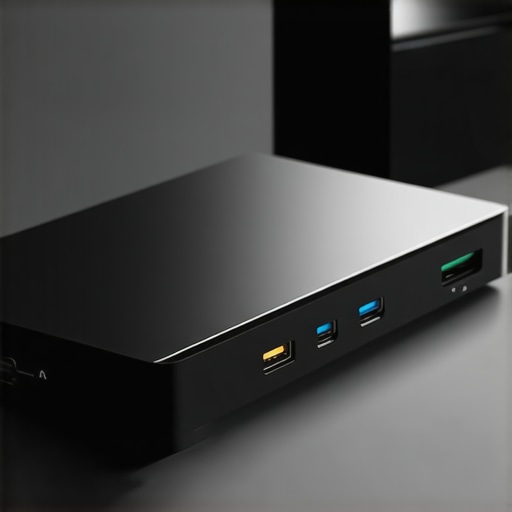
*An illustration of a multi-protocol external SSD dock showcasing Thunderbolt 5, USB 4.2, and PCIe interfaces, emphasizing versatility and high bandwidth capabilities.*
Cybersecurity Considerations in High-Speed Storage Deployment
As throughput accelerates, vulnerabilities related to data interception and unauthorized access inherently increase. Implementing hardware-encrypted SSDs combined with firmware-level security measures becomes paramount. Leveraging hardware modules such as TPMs (Trusted Platform Modules) and end-to-end encryption protocols not only safeguards data in motion but also aligns with compliance standards like GDPR and HIPAA. By embedding security deeply into the storage fabric, professionals can prevent breaches that could compromise high-value or sensitive data during rapid transfers, thus reinforcing trust in high-performance workflows.
Harnessing Modular Storage Architectures for Flexibility and Scalability
Future-proofed external storage solutions are increasingly modular, permitting incremental upgrades without overhauling entire setups. Such architectures integrate seamlessly with evolving interface standards and cooling techniques, providing the flexibility to adapt to burgeoning data volumes. Utilizing interconnects like Thunderbolt expanders and customizable enclosures, organizations can scale capacity and performance linearly. Advanced management tools facilitate real-time monitoring, predictive maintenance, and responsive reconfiguration—elements crucial for environments where data velocity and volume are continuously expanding. For detailed architectural strategies, consult specialized frameworks outlined in Modular Storage Strategies for Data Architects.
Expert Insights & Advanced Considerations
Prioritize Thermal Management to Sustain Peak Speeds
Implementing innovative cooling solutions like liquid cooling interfaces and thermally conductive enclosures is essential to prevent thermal throttling in high-speed external SSDs. Efficient heat dissipation ensures consistent performance during prolonged data transfers, protecting costly hardware investments.
Leverage Firmware with AI Capabilities for Dynamic Optimization
Emerging firmware algorithms embedded with machine learning can adapt in real-time to workload patterns, adjusting throughput, error correction, and temperature regulation. Staying at the forefront involves adopting drives equipped with these intelligent firmware solutions to unlock hidden performance margins.
Design for Scalability with Modular Storage Architectures
Utilize modular enclosures supporting multi-interface connections like Thunderbolt 5 and USB 4.2, allowing seamless expansion of capacity and bandwidth. This scalability is vital for handling growing data demands without compromising speed or reliability.
Enhance Data Security by Integrating Hardware-Based Encryption
With higher throughput comes increased vulnerability; integrating hardware encryption modules and firmware-level security ensures data remains protected during rapid transfers. This approach safeguards sensitive information against interception and unauthorized access effectively.
Curated Expert Resources
- NVMe SSD Performance Secrets — A comprehensive guide on maximizing SSD speeds through interface and firmware optimizations.
- PCIe Throttling Fixes — Industry insights into cooling and firmware tweaks to mitigate speed drops.
- External RAID Configuration Guide — Strategies for building resilient, high-performance storage arrays.
Final Perspective for Storage Professionals
As external SSDs evolve in 2026, attention to thermal dynamics, firmware intelligence, scalability, and security will distinguish successful implementations. High-performance external storage is not just about raw speed; it’s about creating a balanced ecosystem where speed, reliability, and protection harmonize to meet demanding workflows. To harness these innovations fully, stay engaged with authoritative resources and be ready to adapt your strategies as technology advances. For tailored advice or to explore state-of-the-art solutions, don’t hesitate to reach out to our experts. Your next leap in storage performance begins here.