Revolutionizing Data Management with External SSDs and RAID Technologies
In an era where data throughput and reliability are paramount, professionals and tech enthusiasts alike seek to optimize their storage solutions. External solid-state drives (SSDs), combined with advanced RAID configurations, offer unprecedented speed and resilience, transforming workflows across creative, enterprise, and scientific domains.
Decoding the Synergy of External SSDs and RAID for Peak Performance
External SSDs leverage cutting-edge NAND technology and NVMe interfaces to deliver rapid read/write speeds. When integrated into RAID arrays—particularly configurations like RAID 0 or RAID 10—they exponentially enhance data access speeds and fault tolerance. This synergy is critical in scenarios demanding real-time data processing, such as 4K video editing or large-scale data analytics.
Choosing the Right External SSDs for Your Professional Ecosystem
The landscape of external SSDs is diverse, with models distinguished by interface (USB-C, Thunderbolt 3/4), controller quality, and form factor. Experts recommend prioritizing drives with high-end NVMe chips and durable enclosures to withstand rigorous use. For instance, the best external SSDs for RAID combine speed, reliability, and portability, making them suitable for demanding workflows.
Implementing RAID with External SSDs: Technical Considerations
Configuring RAID externally involves hardware enclosures or dedicated controllers that support multiple drives. Software-based RAID solutions in operating systems also provide flexible options but may introduce latency. A critical decision involves selecting the appropriate RAID level: RAID 0 maximizes speed but sacrifices redundancy, whereas RAID 10 offers a balance of performance and fault tolerance. For high-speed data access, RAID 0 with SSDs is often favored, yet enterprise environments prefer RAID 5 or RAID 6 for enhanced safety.
How do I balance speed and data integrity when deploying external SSDs in RAID configurations?
Achieving an optimal balance requires assessing the criticality of data and the acceptable risk levels. Combining SSDs with RAID 10 or RAID 5 provides a compromise between throughput and redundancy. Additionally, employing enterprise-grade SSDs with power-loss protection and high endurance ratings extends lifespan and maintains data integrity during unexpected failures.
For professionals seeking to fine-tune their external storage ecosystems, consulting resources like the comprehensive RAID storage guide for 2025 can offer strategic insights rooted in latest advancements and industry best practices.
As data demands intensify, integrating external SSDs with sophisticated RAID configurations continues to be a frontier for maximizing throughput, minimizing latency, and safeguarding critical information. To explore more about optimizing your RAID setup or for personalized consultation, visit our contact page.
Enhancing Data Throughput with Cutting-Edge RAID Architectures
As data volumes continue to skyrocket, traditional RAID configurations are evolving to meet the demands of high-speed, reliable storage solutions. Innovations such as nested RAID levels, like RAID 50 and RAID 60, combine the best features of speed and redundancy, offering an optimal balance for demanding workflows. These complex arrays leverage external NVMe SSDs to deliver blistering read/write speeds while maintaining data integrity in the face of hardware failures.
Leveraging External NVMe SSDs for Extreme Performance
External NVMe SSDs have revolutionized portable high-performance storage. When paired with advanced RAID configurations, they enable real-time editing of 8K video, large-scale simulations, and rapid data analysis. For professionals, selecting drives with high endurance ratings and advanced controllers—such as those highlighted in NVMe SSD performance secrets—is critical for sustained high-speed operation.
How can you safeguard your high-stakes data without sacrificing speed?
Implementing robust backup strategies alongside RAID arrays protects against data loss. Cloud synchronization, snapshot backups, and off-site storage ensure that even in catastrophic failure scenarios, your data remains accessible and intact. Moreover, integrating enterprise-grade external SSDs with features like power-loss protection and error correction extends device lifespan and ensures data integrity during unexpected disruptions. For guidance on selecting the most reliable external SSDs, consult our comprehensive buying guide.
What are the best practices to optimize RAID configurations for maximum speed and security?
Optimal RAID setup begins with assessing workload characteristics and data criticality. For instance, RAID 10 offers excellent fault tolerance and speed, making it ideal for creative professionals and data scientists. Ensuring your external RAID enclosures support hot-swapping allows seamless maintenance without downtime, further boosting productivity. Additionally, regular firmware updates and routine health checks—guided by tools discussed in the ultimate RAID guide—are essential to sustain peak performance.
To explore more about configuring your external RAID storage for maximum efficiency, consider reading about the latest external SSD solutions and how they integrate with RAID architectures for high-demand environments. Sharing your experiences or questions in the comments can also help build a community driven by best practices and innovative solutions.
Elevate Your Storage Game with Advanced RAID Strategies
As data demands escalate exponentially, traditional RAID configurations often fall short of providing the speed and resilience required by high-performance environments. Enter nested RAID levels like RAID 50 and RAID 60, which ingeniously blend the advantages of RAID 5, RAID 6, and RAID 0, offering both redundancy and lightning-fast data throughput. These complex architectures leverage external NVMe SSDs to facilitate real-time processing of enormous datasets—crucial for AI development, scientific research, and media production. Implementing such configurations demands meticulous planning, including selecting drives with enterprise-grade endurance and ensuring your external enclosures support hot-swapping for minimal downtime.
How External NVMe SSDs Push the Boundaries of Portability and Speed
External NVMe SSDs have revolutionized portable data storage, transforming workflows that once relied on bulky internal drives or slower alternatives. Their integration into RAID arrays—especially configurations like RAID 0 or RAID 10—delivers blistering read/write speeds that enable seamless editing of 8K footage, complex 3D rendering, or high-frequency trading algorithms. For optimal performance, opt for drives with high endurance ratings and controllers that support the latest NVMe standards, such as PCIe Gen4 or Gen5. These drives are not just fast—they are built to sustain prolonged high-speed operations under demanding workloads, making them indispensable for professionals who cannot afford bottlenecks.
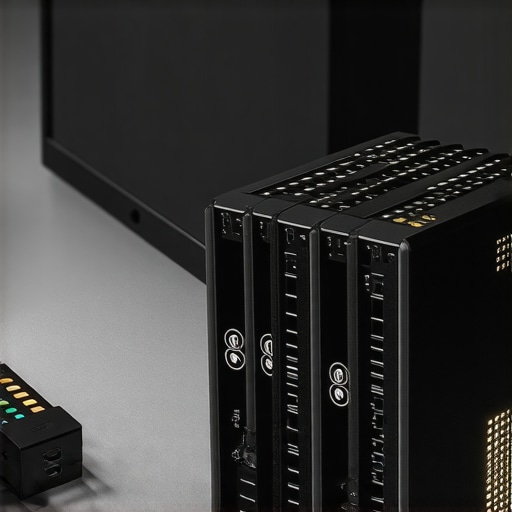
Image prompt: External NVMe SSDs connected to a high-end desktop with RAID setup, illustrating speed and portability, modern tech environment, detailed hardware components, high resolution.
Mitigating Risks: How to Safeguard Critical Data Without Compromising Speed
Speed is vital, but data integrity cannot be compromised—especially in industries where loss of data can result in catastrophic consequences. Combining RAID configurations like RAID 10 with enterprise-grade external SSDs that feature power-loss protection, error correction, and wear leveling ensures a resilient storage ecosystem. Additionally, implementing robust backup strategies—such as cloud synchronization, periodic snapshots, and off-site storage—provides an extra layer of security. For organizations handling sensitive or mission-critical data, integrating hardware encryption and routine health monitoring further fortifies defenses against hardware failures and cyber threats.
What are the nuanced trade-offs when choosing between RAID 5 and RAID 10 for SSD-based external storage?
RAID 5 offers a compelling balance of redundancy and efficiency, utilizing parity to protect data against single-drive failures while maintaining relatively high storage utilization. However, its write performance can suffer due to parity calculations. Conversely, RAID 10, which mirrors and stripes data, provides superior write speeds and fault tolerance but at a higher cost in terms of storage capacity—requiring twice the number of drives for redundancy. The decision hinges on workload specifics: for read-heavy workloads with critical write performance, RAID 10 generally prevails; for environments prioritizing storage efficiency alongside acceptable recovery times, RAID 5 is often preferred. Consulting authoritative sources like the SNIA (Storage Networking Industry Association) best practices can guide optimal configuration choices for your unique needs.
Harnessing Multilayered RAID Architectures for Critical Data Environments
In high-stakes sectors such as scientific research, media production, and financial trading, leveraging layered RAID structures—such as RAID 50 and RAID 60—can dramatically enhance both speed and redundancy. These configurations combine the benefits of striped and parity-based arrays, enabling simultaneous high throughput and robust fault tolerance. Implementing such architectures with enterprise-grade external NVMe SSDs necessitates meticulous planning, including compatibility checks for hot-swappable external enclosures and ensuring support for the latest PCIe standards.
Innovative External SSD Technologies Fueling Next-Generation RAID Applications
The evolution of external SSDs now encompasses PCIe Gen4 and Gen5 interfaces, substantially reducing latency and boosting sustained transfer rates. These drives incorporate advanced features like end-to-end data protection, thermal throttling, and dynamic wear leveling—crucial for maintaining longevity under intensive workloads. When integrated into RAID arrays, such technologies enable seamless handling of real-time 8K editing, complex 3D rendering, and large-scale AI data processing, pushing the boundaries of portable high-performance storage.
What technical considerations are vital for integrating external NVMe SSDs into complex RAID setups?
Key factors include ensuring compatibility between external enclosures and SSD controllers, verifying support for hot-swapping, and selecting drives with high endurance ratings. Additionally, implementing hardware-based RAID controllers with cache acceleration can significantly improve overall throughput. Proper thermal management is equally essential, as high-performance NVMe SSDs generate considerable heat, which can impair stability and lifespan if not adequately addressed. Consulting detailed specifications from reputable sources like the SNIA’s Storage Architectures Guide can clarify best practices for such integrations.
To stay ahead in high-performance data management, professionals should continuously evaluate emerging SSD technologies and RAID innovations, tailoring configurations to their unique workload demands. Engage with industry forums, attend specialized webinars, and subscribe to authoritative publications such as the SNIA Storage Networking Industry News to refine your storage strategies.
Leveraging AI-Driven Monitoring for Sustained RAID Performance
Incorporating AI-based health monitoring tools into your RAID environment allows proactive detection of drive degradation, temperature anomalies, and potential failure points. These intelligent systems analyze real-time telemetry data, enabling preemptive maintenance actions that minimize downtime and data loss. External external NVMe SSDs equipped with self-monitoring features, combined with AI analytics, form a formidable defense against hardware failures, ensuring sustained high-speed operations in demanding scenarios.
Can you optimize your RAID setup to balance speed, security, and scalability?
Achieving this balance involves selecting drives with enterprise-grade features like power-loss protection, error correction, and high write endurance, alongside configuring RAID levels that match your data safety requirements. For instance, combining RAID 10 with SSDs that support hardware encryption offers both performance and data security. Additionally, employing modular external enclosures with hot-swappable bays facilitates scalability and maintenance without system downtime. Regular firmware updates, coupled with routine health checks—guided by tools from industry leaders—are essential to maintain peak performance and resilience.
For in-depth guidance on optimizing your RAID configurations, explore resources like the SNIA’s Best Practices for Storage Infrastructure Design, which provide comprehensive technical insights. Engaging with professional communities and consulting with storage specialists can further tailor solutions to your specific operational needs.
Harness Cutting-Edge Storage Techniques for Data Enthusiasts
In the relentless pursuit of speed and reliability in data management, experts recognize that integrating external SSDs with sophisticated RAID architectures is transformative. Leveraging these technologies requires not only understanding their individual capabilities but also mastering their synergy to unlock maximum potential.
Prioritize Drive Endurance and Compatibility
Utilize enterprise-grade NVMe SSDs with high endurance ratings and ensure compatibility with your external enclosures. This proactive approach prevents bottlenecks and extends device lifespan, especially in high-demand environments.
Optimize RAID Configurations for Specific Workloads
Choose RAID levels aligned with your priorities—RAID 0 for blistering speed, RAID 10 for balanced performance and redundancy, or nested levels like RAID 50 for enterprise-level resilience. Tailor each setup to your unique data throughput and security needs.
Implement Robust Backup and Security Measures
Complement your RAID setup with comprehensive backup strategies, including cloud synchronization and off-site storage. Incorporate hardware encryption and error correction to safeguard sensitive information during high-speed transfers.
Stay Ahead with Emerging Technologies
Monitor developments in PCIe Gen5 SSDs, AI-driven health monitoring tools, and advanced thermal management solutions. Integrating these innovations ensures your storage infrastructure remains at the forefront of performance and reliability.